In This Guide
- What Does "Intermediate Skier" Really Mean? Defining Your Stage
- The Core Skills Every Intermediate Skier Needs to Drill
- Gear Talk: Is Your Equipment Holding You Back?
- Tackling New Terrain: A Step-by-Step Mindset
- The Role of Fitness & Off-Season Prep
- Common Intermediate Skier Questions (Answered Honestly)
- Putting It All Together: Your Action Plan
Let's be honest. The intermediate skier plateau is real. You're past the pizza-and-french-fries stage, you can confidently link turns on blue runs, and you might even sneak onto a groomed black diamond when the light is just right and nobody's watching. But then... what? You feel stuck. The jumps in the terrain park still look terrifying, moguls feel like a personal assault, and powder? That's for the people in the movies and the locals who seem to float effortlessly.
I've been there. I spent what felt like three whole seasons calling myself an "intermediate skier," cruising the same comfortable runs, feeling a flicker of anxiety every time a friend suggested something steeper or bumpier. The progression wasn't happening, and it was frustrating. Sound familiar?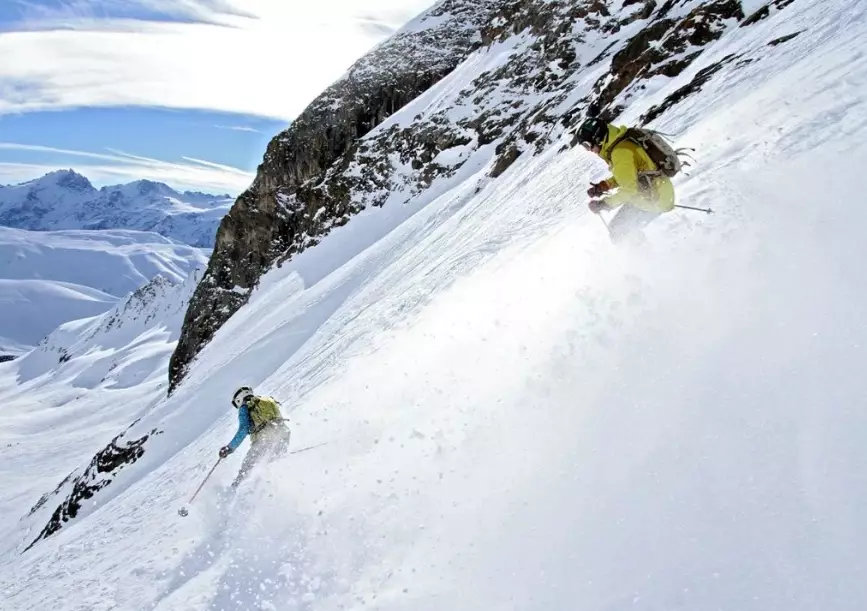
This guide is for that skier. The one who's ready to move beyond the plateau. We're not just talking about vague tips; we're digging into the specific skills you need to hone, the mental game you have to win, and the gear choices that actually make a difference at this level. Forget just getting down the hill. Let's talk about mastering it.
What Does "Intermediate Skier" Really Mean? Defining Your Stage
It's a fuzzy label, isn't it? One resort's blue is another resort's black. But most ski instruction bodies, like the Professional Ski Instructors of America & American Association of Snowboarders (PSIA-AASI), break it down by skill, not just trail color.
An intermediate skier typically:
- Links parallel turns consistently on blue (intermediate) groomed runs.
- Can control speed and direction using turn shape, not just skidding.
- Has a basic understanding of edge control but might still rely on the inside edge of the outside ski more than the outside edge.
- Feels comfortable at moderate speeds but may get thrown off by sudden changes in snow conditions (ice, heavy crud).
- Looks at moguls, trees, and deep snow as "expert" terrain, not "next-step" terrain.
If you're nodding along, you're in the right place. The jump from here to advanced isn't about brute force; it's about refinement and expanding your toolbox.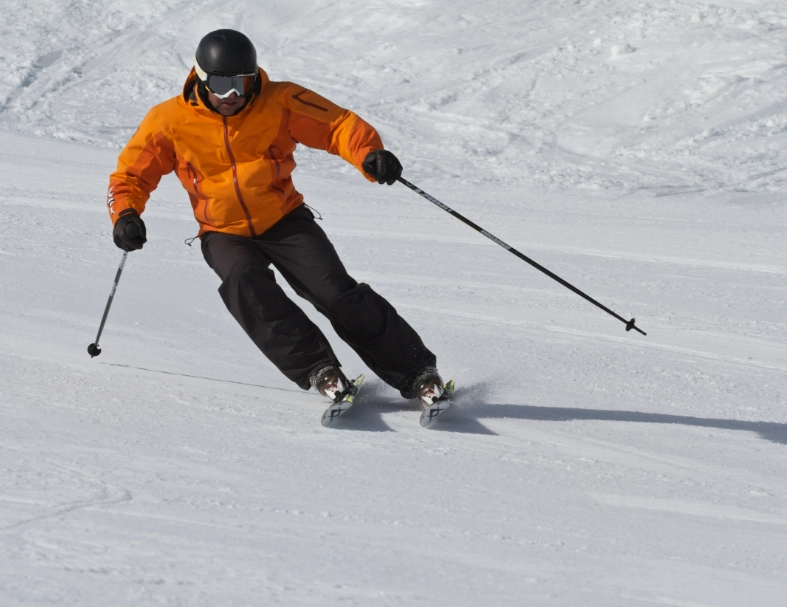
The Core Skills Every Intermediate Skier Needs to Drill
You can't build a house on a shaky foundation. Before you dream of carving trenches or floating through powder, these are the non-negotiable skills you need to own. And I mean really own.
1. Independent Leg Action & Angulation
This is the big one. Beginner turns often use the whole body as one unit. Advanced skiing is about your legs working independently under a stable, quiet upper body.
What it feels like: Imagine your hips and shoulders are a tray of drinks you're carrying. You can't spill them! Your legs extend and retract, tilt and press, but that tray stays level and facing downhill. This separation creates "angulation"—the angles in your knees, hips, and ankles that let you grip the ice and pressure your edges without your whole body leaning into the hill.
Drill to try: On a gentle slope, practice making turns using only your lower body. Keep your hands on your hips and your shoulders pointed straight down the fall line. Feel your feet rolling from edge to edge while your core stays still. It feels weird at first, but it's a game-changer.
2. Dynamic Balance & Fore/Aft Control
Balance isn't a static thing. It's active. An intermediate skier often gets "in the backseat" when scared, putting weight on their heels. This kills control and tires you out fast.
You need to feel comfortable with your weight centered over the middle of your ski, and be able to move it forward to initiate a turn and pressure the shovel, or slightly back to handle choppy snow. The goal is to use the entire length of your ski as a tool.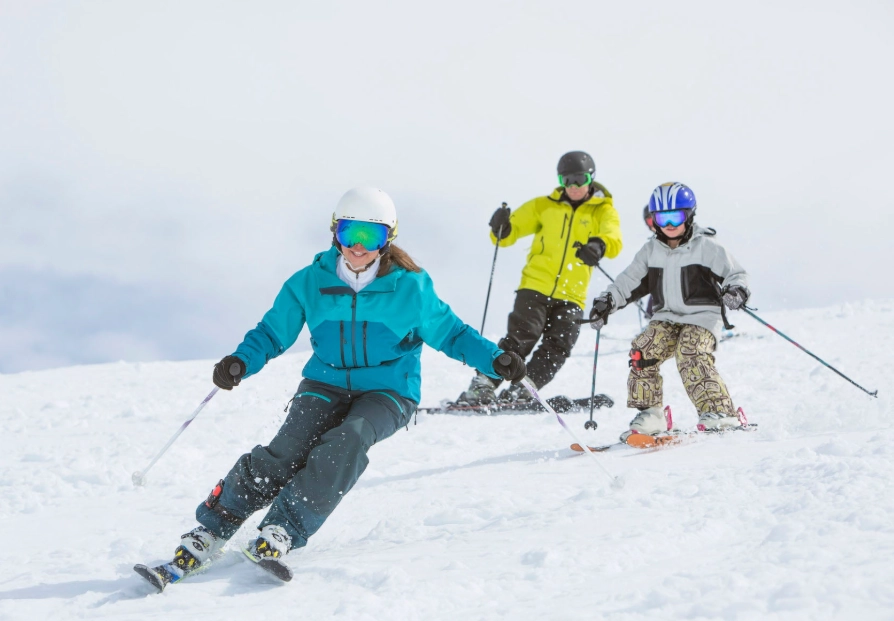
Common pitfall: Leaning forward doesn't mean bending at the waist and sticking your butt out! It's an ankle flex, bringing your shins firmly into the front of your boots. If your boot tongues aren't worn out, you're probably not doing it enough.
3. Carving vs. Skidding: Understanding the Difference
This is the heart of efficient, high-performance skiing. A skidded turn uses the ski's base to scrub off speed sideways. A carved turn uses the metal edge to track like a train on rails, converting speed into energy for the next turn.
Most intermediates are making glorified skidded parallel turns. Learning to carve—even just a little—feels like unlocking a cheat code. It's smoother, faster, and less tiring. The key is committing to your edges and letting the sidecut of the ski do the work.
How do you know? A carved turn leaves two clean, pencil-thin lines in the snow. A skidded turn leaves a wider, fan-shaped smear.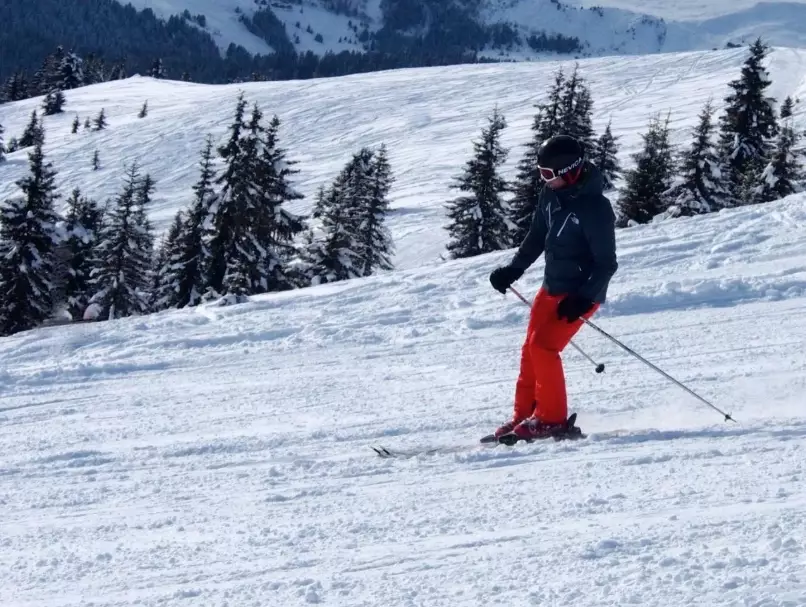
Gear Talk: Is Your Equipment Holding You Back?
You learned on rental skis that were soft, forgiving, and probably too short. They were perfect for learning. But now, they might be your ceiling. The right gear for an intermediate skier provides feedback and support for developing better technique.
Here’s a breakdown of what to look for when you're ready to invest in your own setup:
| Equipment | Beginner Focus | Intermediate Sweet Spot | Why the Change Matters |
|---|---|---|---|
| Skis | Soft flex, short length, full rocker or rocker-camber-rocker. Forgiving and easy to turn. | All-Mountain Frontside Skis. Medium flex, waist width 75-85mm. Camber underfoot with early rise tip/tail. Provides stability for carving on groomers and versatility for light off-piste. | More camber gives you better edge hold on hardpack. A slightly stiffer flex provides stability at speed and transmits your input more directly. You'll feel the snow more. |
| Boots | Soft flex (60-80), often a "comfort" fit with lots of room. | The MOST important investment. Get professionally fitted! Look for a flex of 90-100. Fit should be snug, not painful. A stiffer boot gives you more precise control and support. | Boots are your steering wheel. A proper, snug fit eliminates slop and lag between your movement and the ski's reaction. A stiffer flex supports your ankles as you develop stronger edging movements. |
| Poles | Often an afterthought. | Correct length is key. With boots on, hold pole upside down under basket. Your forearm should be parallel to the floor. | Proper poles aid rhythm and timing, especially in moguls and off-piste. They're not just for pushing. |
My two cents? Don't cheap out on boots. A great boot with mediocre skis will serve you better than the world's best skis in a sloppy boot. Go to a certified bootfitter, not just a big-box store. It's worth every penny.
Tackling New Terrain: A Step-by-Step Mindset
Fear is the number one limiter for the intermediate skier. Here’s how to strategically approach terrain that scares you.
Moguls (Bumps)
They look chaotic, but they have a rhythm. The mistake is trying to fight each bump individually.
- Start small: Find a run with small, spaced-out bumps on the side. Don't go straight into a steep, bumped-out black diamond.
- Look ahead: Pick your line 2-3 bumps ahead. Your body will follow your eyes.
- Absorb and extend: Use your legs as shock absorbers. As you climb the back of a bump, extend your legs. As you go down the front, retract them. Keep your upper body facing downhill.
- Use the troughs: The lines between bumps are your friends. Turn in the valleys, not on the peaks.
Powder
It's a different sport, and it's glorious. But it requires a mental and physical shift.
- Get the right skis (or at least rent): A wider ski (95mm+ underfoot) makes life infinitely easier. It provides float.
- Sit back (a little): This is the one time you intentionally shift your weight back to keep the ski tips from diving. Think "balanced in the middle of the ski," but be ready to lean back if you feel the tips sink.
- Make rounded, sweeping turns: Sharp, quick turns will bury you. Let the skis plane on the surface.
- Stay loose: Powder is forgiving. If you fall, it's a soft cloud. Embrace it!

Steep Terrain (Blacks & Double Blacks)
The mental game here is 80% of the battle.
The key isn't to ski it faster, but to commit to your first turn. The scariest part is the top, looking down the sheer face. Pick a spot just below you for your first turn. Make that turn decisively. Once you're across the hill, you've broken the spell. Now just link one turn at a time. Don't look at the bottom; look at your next stopping point.
Also, check the trail map and avalanche safety resources if you're venturing into uncontrolled backcountry terrain. Steep in-bounds is one thing; steep in the backcountry is a whole different level of risk management.
The Role of Fitness & Off-Season Prep
Skiing is an athletic sport. Being in shape isn't just about lasting longer; it's about having the strength to hold good form when you're tired on your last run (when most injuries happen).
Focus on:
- Leg Blasters: Squats, lunges, box jumps. Build explosive power.
- Core, Core, Core: A strong core keeps you stable and protects your back. Planks, Russian twists, dead bugs.
- Balance & Proprioception: Single-leg balances, Bosu ball work. This trains the little stabilizer muscles that keep you upright on variable snow.
- Cardio: You're at altitude. Good cardiovascular fitness fights fatigue and helps with recovery.
I neglected this for years and would be wrecked by day 3 of a trip. Once I started a simple pre-season routine, my technique didn't fall apart in the afternoons, and I had way more fun.
Common Intermediate Skier Questions (Answered Honestly)
Putting It All Together: Your Action Plan
Feeling overwhelmed? Don't be. You don't have to do everything at once. Here’s a simple, non-linear plan to get you progressing.
- Get Your Boots Sorted. Book that appointment with a bootfitter. It's step zero.
- Book a 2-Hour Private Lesson. Tell the instructor exactly what you told me: "I'm an intermediate skier stuck on blues. I want to ski blacks confidently and handle variable snow." Be specific.
- Pick One Skill Per Day. Next time you're on the mountain, dedicate your first hour to just one drill. Maybe it's quiet hands. Maybe it's feeling your edges. Focused practice beats mindless laps.
- Find a Slightly Better Skiing Buddy. Ski with someone who pushes you just a little bit out of your comfort zone. Not someone who drags you down double-black chutes, but someone who suggests a black groomer you've been eyeing.
- Celebrate Micro-Progress. Did you make three linked turns in the bumps without stopping? Did you carve three turns in a row on a blue? That's a win. Progress is incremental.
The journey from intermediate to advanced is the most rewarding phase in skiing. You go from participating to truly understanding the sport. You start to feel the snow, read the mountain, and move with intention.
It's not about being fearless.
It's about being in control, even when you're scared. That control comes from building a foundation of solid skills, having the right tools, and adopting a mindset of playful, deliberate practice. So get out there, pick one thing from this guide, and work on it. The mountain is waiting.
Related Articles
Comments
Join the discussion